Places in Spain for Couples Over 50 — Slower, Quieter, and Worth Every Detour

We landed in Sevilla, and it immediately exceeded every expectation we had about Spain.
We’d heard it was good. We weren’t prepared for quite how good. But more on that later.
What we’d deliberately chosen to skip was Barcelona. Locals were taking to the streets at the time, fed up with what mass tourism had done to their city, apartments hollowed out by short-term rental platforms, neighbourhoods slowly emptied of the people who actually belonged in them.
It didn’t feel like the right moment to add ourselves to that, so we didn’t. No regrets whatsoever, and we totally support those locals. This is also a great way to promote some of the places that deserve a bit more attention.
We finished the trip in Madrid, and genuinely enjoyed it. But even there, we noticed the difference between seeing a place and actually feeling it. The famous sights were impressive. The busy squares were fun for an hour.
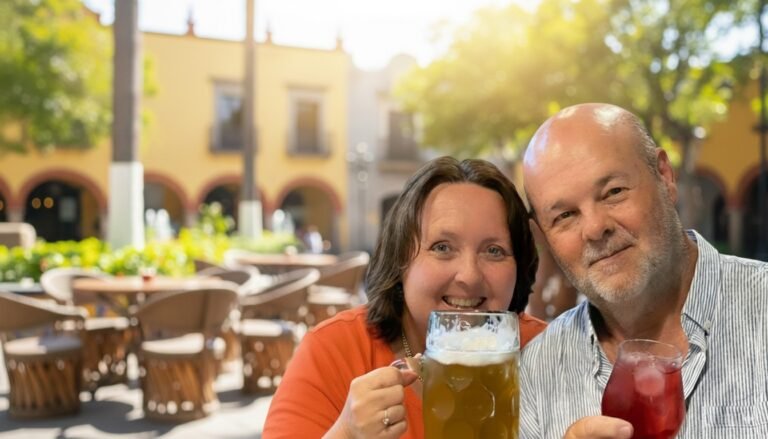
The real connection, though, had happened weeks earlier — sitting in a quiet town square somewhere in the middle of Spain, no tour group in sight, tinto de verano in hand, watching the afternoon do absolutely nothing in particular.
That’s when it clicked. This is what we came for.
That’s the kind of travellers we are. Curious, but not in a hurry. More interested in what’s around the next corner than in ticking off what’s in the guidebook.
If a place looks interesting, we stop. If lunch turns into two hours, that’s a good lunch.
If that sounds like you, here’s what we can tell you: Spain works beautifully at that pace — but only once you get beyond the places everyone already knows about.

Why look past Barcelona and Madrid?
The lesser-known destinations in this post are quieter, more affordable, and frankly more interesting than anything we found in the big tourist centres. You won’t feel like you’re missing out. You’ll feel like you’ve found the real Spain.
These are the ten places that gave us the real Spain — the history, the food, the unhurried afternoons, and more than a few moments that are genuinely hard to describe to people who weren’t there. We’ve also put together a road trip route that connects them all, because the drives between these places turned out to be just as much a part of the story.
And for those of you who prefer the melodious sound of our voices, you can watch the companion video we created.
And we’ve even thrown in a road trip route that ties them all together as a bit of a bonus. So, let’s get this show on the road, and why not start with somewhere you may not know, but you really should.
Albarracín: Where the Walls Tell the Story
Best for:
couples who want to slow down inside history rather than observe it from a distance, anyone who appreciates architecture and landscape together, photographers who understand the value of being somewhere where you don’t have to fight for some space.
Think carefully if:
steep, uneven terrain is a genuine challenge for you, or if you need a wide range of dining and entertainment options to feel comfortable.

Nothing quite prepares you for that first view.
You’re driving through pleasant countryside, pine forest on either side, and then the road curves and suddenly there it is… ancient walls snaking up and over the hillside, pinkish-red stone against the sky, a medieval town clinging to the rock below them as if it grew there.
We both went quiet for a moment and pulled off the road to take it all in. Some places announce themselves, and Albarracín is one of them.
Getting around the town itself is a different kind of experience. The lanes are steep, cobblestoned, and narrow enough that two people walking side by side occasionally need to form a single line.

If you have any significant mobility concerns, it’s worth knowing that upfront; this is not a flat town. And the car parking, in most cases, will leave you several hundred metres from your apartment or hotel.
But if you’re reasonably comfortable on your feet and take it at your own pace, the reward is a place that feels genuinely, unhurriedly medieval in a way that very few towns in Europe still manage.
We stayed a few nights, which turned out to be exactly the right call. Day visitors come through, see the main square, walk a section of the walls, and leave.
Staying means you get the town at dusk when the light on the stone is extraordinary, and again in the morning before anyone else is moving. That’s when Albarracín stops feeling like a destination and starts feeling like somewhere you actually live, if only briefly.

Where we stayed:
We could not have chosen a better location or apartment for our stay, except for the long walk on bumpy lanes with luggage. The Portal de Molina 2 featured a back door that brought you out right next to the wall on the hill, and a warm and comfortable stay.
For people who travel to feel connected to history rather than just photograph it, those quiet hours alone are all the reason you need to be here.

One honest note on food: options are limited. This is a small town, not a culinary hub, and if you arrive expecting variety, you’ll be mildly disappointed.
What’s there, though, is good — local and unfussy, the kind of meal that tastes right because you’re eating it in exactly the right place. Plan around the restaurant hours, don’t leave it too late, and you’ll eat well.
Consuegra: Wait for the Last Bus to Leave
Best for:
anyone who appreciates landscapes, history, and the satisfaction of having a famous place almost entirely to themselves. Patient travellers who understand that the best version of somewhere is often the one you find after the crowds leave.
Think carefully if:
you need full itinerary days to feel a stay is worthwhile, Consuegra rewards patience over activity, and that doesn’t suit everyone.

Here’s the best piece of advice we can give you about Consuegra: arrive in the afternoon, and let the tour buses finish their work first.
We got there to find the ridge doing its job as advertised. Windmills lined up against the sky, the castle at one end, a handful of visitors dutifully photographing all of it.
We joined them for a while, then found a spot and waited. And as the last coach pulled away down the hill and the car park quietly emptied, the whole place changed.
Just us, the windmills, the castle, and a sunset that turned the sky extraordinary colours over a landscape that feels, in the most pleasing way possible, like it exists in the middle of absolutely nowhere.
That’s the moment when Consuegra earned its place on this list.
The windmills are easily reached by car, parking is available at multiple points along the ridge, so there’s no significant walking required to get among them.

The Don Quixote connection is a genuine footnote rather than the main event for most visitors, though if Cervantes or The Man of La Mancha means something to you it adds a pleasing layer of literary atmosphere to the whole thing.
For the right person, standing where those fictional giants were imagined would be quietly thrilling.
One night is the right call here. There isn’t enough to really justify two, but leaving without experiencing that late afternoon light would be a genuine missed opportunity.

Where we stayed:
The apartment we stayed at in Consuegra deserves a special mention. Apartamentos Oncemolinos con desayuno sits with a direct view of the windmills from its private terrace, which on its own would be enough.
But what made it memorable was the detail. The fridge was stocked to a standard we’ve rarely encountered anywhere, and when we arrived we found a breakfast picnic basket in the room — generous, thoughtful, and with far too much food for two people, which in our experience is exactly the right amount for a good start to the day.
It was the kind of welcome that makes you feel like a welcomed guest rather than just another tenant, and in a town with limited dining options, the cooking facilities were also genuinely valuable.
On that note, do your research before you arrive. Certain days of the week see most of Consuegra’s restaurants closed simultaneously, which caught us slightly off guard.
We were fortunate to have cooking facilities and found a small supermarket and a good vegetable shop nearby. It worked out pretty well, but it’s not something you want to discover at 7pm on an empty stomach. Which is how we found out!
Córdoba: A Delicious Snack Between Two Big Meals
Best for:
walkers and wanderers, anyone who appreciates history without the sensory overload of a larger city, couples who want somewhere to stop and catch their breath between bigger destinations.
Think carefully if:
you’re pressed for time and treating it purely as a stopover, Córdoba rewards slowing down, and a single rushed day doesn’t do it justice.

That’s genuinely the best way we can describe Córdoba’s place on this route. Sevilla and Granada are two of Spain’s heaviest hitters, magnificent, full-on, demanding of your attention and your energy.
Córdoba sits between them like a perfectly timed break. Not any less worthwhile. Just different. A delicious snack between two big, heavy meals.
We arrived in October, which turned out to be close to ideal. The temperature was genuinely pleasant for walking, the tourist numbers were there but manageable, and the old town, almost entirely flat, a rarity in Andalucía, rewarded the kind of aimless wandering we like best.
If you enjoy getting slightly lost in a maze of laneways with no particular agenda, Córdoba is made for you. Every wrong turn seems to deposit you somewhere worth seeing.

The Mezquita is as impressive as its reputation suggests, those endless red and white arches are one of those sights that will genuinely stop you mid-step.
What we hadn’t anticipated were the orange trees filling the courtyard outside, which added something unexpectedly cheerful to the whole experience.
We were also fortunate enough to arrive during a small outdoor concert being held in the courtyard, entirely unplanned on our part. Just perfect timing on a late afternoon, early evening.
It was the kind of moment that no guidebook can promise you, which is precisely why it stays with you.
Unfortunately we missed the famous Festival de los Patios, that’s a spring event where locals open their flower-filled private courtyards to visitors, but discovered that some courtyards remain accessible to visitors outside the festival period.
It was a small unexpected bonus, the sort of thing you only find by exploring rather than rushing through.
We recommend staying at least a few nights to experience more than just the obvious attractions, and find accommodation just outside the city, across the river.
And speaking of the river, make sure to take in the view from that end of the Roman bridge towards the city. It’s one of those views that reframes everything, the old town stacked up across the water, the Mezquita anchoring it all, the light doing what Andalusian light does at that hour.
That moment, more than anything inside the city, is what we remember most about Córdoba.

The Alcázar gardens are worth a separate mention. There’s a small entrance fee, and it’s worth paying. The combination of formal fountains, beautifully maintained grounds, and some genuinely clever and quirky topiary work makes it one of the more quietly pleasing hours you can spend in Córdoba.
It’s the kind of place you wander into expecting to stay thirty minutes and leave ninety minutes later, wondering where the time went. A lovely counterpoint to the grandeur of the Mezquita, and a good place to simply sit and let the city settle around you.
Our three nights gave us a comfortable overview with room to breathe. We could easily have stretched it further.
On the food front — the cold soup tradition here runs deep, but if that’s not your thing [it wasn’t ours] there’s plenty beyond it. We tried Flamenquín Cordobés, a local pork dish, and Pastel Cordobés, a sweet pastry that’s worth finding. Both should be tried if you see them on a menu or in a bakery.
Denia & Benidorm: Two Towns, One Coast, Very Different Conversations
Best for:
Denia suits couples who want more authentic coastal Spain, local atmosphere, excellent food, and a castle worth the climb. Benidorm suits those who value convenience, active beach days, and plenty of dining options, provided they’re comfortable finding their own corner of it.
Think carefully if:
couples who want to slow down inside history rather than observe it from a distance, anyone who appreciates architecture and landscape together, photographers who understand the value of being somewhere where you don’t have to fight for some space.

Let’s be straightforward about something: Denia and Benidorm are not the same kind of place, and the contrast between them is not subtle. Drive from one to the other, and you feel the vibe change almost immediately.
From a relaxed Spanish coastal town going about its own business to a resort built largely around making British expats feel at home. Neither is wrong. They’re just very different, and knowing which one suits you matters.
We spent three days in each, using both as bases for exploring some of the smaller, beautiful towns scattered through the surrounding area during the days.
That turned out to be the right approach. The region rewards that kind of unhurried exploration, and having a comfortable base to return to each evening made it work well.
Denia won us over quickly. The castle dominates the skyline in the most satisfying way, and climbing up to explore the full grounds is worth the effort. The coastal and city views from up there are genuinely impressive.

A word of warning: the walk up and the size of the grounds are a reasonable challenge in the heat, so pick a cooler part of the day if you can. Advice I wish we had been given before tackling it in the middle of the day.
Denia’s seafood game is reputedly strong, and if you arrive earlier in a trip than we did, you should absolutely take advantage of it. We’d already been travelling for weeks with more seafood ahead of us, so we made a different call entirely and found ourselves at an extremely good curry restaurant one evening when we simply needed a night off from Spanish food.
No regrets. Sometimes a break from the local cuisine is exactly what you need.
Benidorm requires a little more navigation, but it has more to offer than its reputation suggests if you know which end to head for. The northern end is unambiguously set up for a particular kind of British holiday: loud, lively, and perfectly happy about both.

If that’s not your scene, and it certainly isn’t ours, just keep driving south. The southern end is quieter, noticeably more local in character, and sits much more comfortably alongside the way we prefer to travel.

Where we stayed:
Our apartment in Benidorm, Apartment Susanne was in a quiet residential area at the local end of the beach, and the sunrise views were incredible. Plus it was only one block from the beach and surrounded by nice restaurants and a gelato shop.

Here’s the practical case for Benidorm if you want to stay in one place: the dining options are considerably broader, even away from the nightlife end. More restaurants, more variety, more flexibility for lunch and evening meals.
If Denia appeals more as a day trip than a base, that calculation makes sense.
The Ibiza ferry connection from Denia exists and is worth knowing about, though it’s probably not a priority for most people travelling at our pace.
Granada: Book the Alhambra. We Are Begging You.
Best for:
curious travellers who are happy to wander without a fixed plan, anyone drawn to layers of history and culture in a single place, couples who appreciate a neighbourhood with genuine character to stay in rather than just pass through.
Best for:
the Alhambra interior is the primary reason you’re going and you haven’t secured tickets well in advance. Go anyway, but manage your expectations and let the city surprise you.
Think carefully if: the Alhambra interior is the primary reason you’re going and you haven’t secured tickets well in advance. Go anyway, but manage your expectations and let the city surprise you.

Let’s start with a confession that Pauline would probably prefer I didn’t share quite so publicly.
We arrived in Granada without Alhambra tickets. Not because we forgot, and not because we didn’t know we needed them. It was simply the nature of how we travel.
We’d been booking our road trip one stop ahead the entire time, following our instincts rather than a fixed itinerary, and it had served us beautifully right up until the moment we discovered that Alhambra tickets were sold out for the next four weeks.
Pauline was, to put it diplomatically, not pleased with me.
The lesson is simple, and we’ll only say it once: if the Alhambra matters to you, book it the moment your flights are confirmed. Months ahead, not weeks. Do not do what we did.
What happened next, though, almost made up for my indiscretion.

It turns out a significant portion of the Alhambra grounds, including gardens and several buildings, are open without tickets. The walk up is long and genuinely steep, and for anyone with significant mobility limitations, it’s worth knowing that taxis and other options exist for getting up the hill.
But if you can manage it, the gardens, the views, and simply the atmosphere of the place make the effort worthwhile. Pauline’s frustration softened considerably once we were up there. The aura of the Alhambra, even experienced this way, is something you feel rather than just see.
We stayed in the Albaicín neighbourhood, which turned out to be a wonderful decision. It’s the old Moorish quarter, full of character, and yes, it’s hilly. But the lookout points are generous with seating, the views across to the Alhambra are extraordinary, and wandering its lanes without any particular destination in mind suited us perfectly.

Where we stayed:
This apartment was one of the best of our entire time in Spain, and in the historic Albaicín section of the city. Quiet, huge, and beautifully appointed. Casa Indalo is a fantastic place to base your stay.
For those who prefer flatter ground, the lower parts of the city still offer a remarkable amount of history and culture without the climb.
The Arab quarter deserves more than a passing mention.
The aromas hit you before you’ve decided where to go, spices and grilled meat drifting out of restaurants that line the lanes, and the Turkish delight comes in more flavours than we’d imagined possible. We tried almost all of them. Possibly more than was strictly necessary.

Four nights gave us a comfortable but not exhaustive experience of Granada, and we left with the clear feeling that we’d only scratched the surface. If we return, and we’d like to, we’ll stay longer.
We’ll also book the Alhambra approximately the moment we decide to go.
Ronda & Setenil de las Bodegas: Look Away From the Bridge
Best for:
anyone who appreciates dramatic landscapes and the satisfaction of finding a better angle than the obvious one, couples who want a relaxed base with genuine character, people who understand that the best version of a famous place usually requires staying longer than a day trip allows.
Think carefully if:
you want to see more of the city than just the bridge but planning to only be there for part of a day. You’ll see the postcard. You’ll miss Ronda entirely.
Think carefully if: you’re visiting purely for the bridge and planning to move on the same day. You’ll see the postcard. You’ll miss Ronda entirely.

Everyone at Ronda is looking at the bridge. We’d suggest occasionally looking somewhere else.
That’s not a criticism of the Puente Nuevo. It’s genuinely one of the most dramatic structures we’ve seen anywhere in Spain, an 18th-century bridge spanning a gorge so deep you have to remind yourself it’s real.
But the tourist instinct to plant yourself on it at sunset, shoulder to shoulder with hundreds of other people all pointing cameras in the same direction, means most visitors miss the two views that are actually worth having.
The first is from further along the river within the city itself. As the sun drops, find a vantage point looking back at the bridge and the gorge together. That’s a lovely view, and more importantly, that’s the moment.
The second is next to the bridge when sunlight blazes through the gap, shadows fall in a way that no photograph can do justice, and you’re watching it without anyone’s elbow in your face.

The third view requires a short drive just outside of town to a lookout positioned below the bridge. From here you get the full picture, the bridge above, the town behind it, the gorge dropping away beneath.
And finally, there is the beautiful view of the bridge that none of the day trip tourists get to experience… at night the bridge is quiet and beautifully lit. It’s really quite magical and should be enough reason to make you saty at least one night.

What surprises most people about Ronda, once they look up from their cameras, is how flat and easy it is to walk. The reputation of Andalusian hilltop towns tends to make people brace themselves. Don’t.
The town itself is very manageable, the crowds arrive in waves with the tour buses and recede again by early evening, and once they’ve gone, Ronda gets to show you what it actually is beyond the famous view. Unhurried, charming, and considerably more substantial than a single bridge.

Where we stayed:
Parking can be a real issue during the day, but we found street parking available once the day trippers had moved on. We chose Puerta Alameda Suites Mirador Centro Historico, a great apartment right in the centre of town, with an easy walk to the bridge, bull ring, and restaurants.
Three nights suited us well. We used one of the days to have a day in Setenil de las Bodegas, which turned out to be the right decision entirely. Staying overnight in both places, packing and unpacking for one additional night would have added friction without adding much value, and the drive between the two is short enough that a day trip works perfectly.
For those without a car, day trips from Ronda can be arranged.
Setenil is a genuinely difficult place to describe to someone who hasn’t been there. You’ve seen photos. You think you know what to expect.
And then you’re actually walking along a street built underneath an enormous overhanging cliff, stepping into shops and cafés that have been carved into the rock, and some part of your brain keeps insisting this must be a film set. It isn’t. People live here. They always have.

We spent half a day there, which felt right. You could stretch it to a full day if you wanted to browse more slowly through the shops, but beyond that, you’d be might be struggling for things to fill the time.
Before heading back to Ronda we found a small restaurant called Terracota, sitting further down the river and itself built into the cliffs. We had ice cold smoothies and crispy montaditos and sat there longer than we’d planned, which is generally our measure of a good find.
San Sebastián: The Detour That Paid Its Debts
Best for:
food lovers, couples who want a complete change of pace and scenery mid-trip, anyone who appreciates a city that functions beautifully as a place to simply be, rather than a place with a list of things to do.
Think carefully if:
you’re visiting in peak summer and haven’t budgeted for higher prices and bigger crowds. The shoulder season version of this city is the one we’d send you to.

This one needs a little context.
San Sebastián was never supposed to be on this trip. We’d originally planned a longer route that included more of northern Spain, but when we had to trim the itinerary it was the first thing to go. Pauline was disappointed. I filed it away and moved on.
Then the devastating floods hit Valencia, and we suddenly found ourselves with four days and nowhere to go. Pauline didn’t hesitate. San Sebastián, she said.
It was considerably out of our way, which meant two long driving days to make it work. But after the Alhambra situation, I was in no position to argue.
It was, without question, one of the best decisions of the entire trip.
After a month of immersing ourselves in the heat, history and culture of Andalucía and central Spain, arriving in San Sebastián felt like stepping into a different country entirely.
The architecture is different, the language shifts, the food is completely its own thing, and the pace of life has a different quality to it. It’s the kind of place that makes you exhale without quite realising you’d been holding your breath.

The old quarter is the heart of it, a neat grid of about a dozen streets arranged in an almost perfect criss-cross pattern. Walk in from any direction and within minutes you’ll find pintxos bars, one after another, each with a counter loaded with small bites that range from simple to extraordinary.
One evening we spent three hours moving between bars, trying a couple of pintxos at each with a drink alongside. By the end we were comfortably full and, it has to be said, somewhat pleasantly intoxicated. We’re not sure exactly how many bars we visited. We lost count.
One thing we knew when we arrived was that France was practically next door. Saint-Jean-de-Luz is just across the border and an easy day trip, which we’d suggest taking purely for the pleasure of having a croque monsieur or something equally French after days of pintxos.
It sounds trivial but it’s actually a lovely reminder of just how far north you’ve travelled, and how different this corner of Spain feels from everything else on this route.

La Concha beach surprised us. We’d expected a pretty backdrop and found something that felt more like the actual soul of the city.
We didn’t swim, but we walked the promenade regularly, partly because it was a genuinely lovely stretch of coastline with a wide bay and good sand, and partly because our hotel was up on a hill at one end and the old quarter was at the other. The walk along the water was no hardship.
The walk back up the hill after the pintxos evening was considerably more of one.
A note on that hill: some of the accommodation in San Sebastián sits higher up with genuinely spectacular views over the bay. Worth it, but worth knowing about in advance. If hills are a concern, look for something closer to the flat promenade level.

Where we stayed:
Hotel Avenida was lovely, with a great pool and spectacular views, especially at sunrise. The view comes at the cost of being an uphill climb when returning at the end of an evening.

We were there in late October, which turned out to be close to ideal. Shorts and t-shirts during the day, cool and comfortable in the evenings, prices at shoulder season rates and crowds at a manageable level.
We’d strongly recommend timing a visit outside the peak summer period, not just for the cost and the quieter streets, but because the heat of a Basque summer apparently changes the character of the place considerably. The version we experienced felt just right.
Four nights were enough to properly recharge without feeling like we were hiding from the rest of the trip. If you want a few days by the sea without the party atmosphere of the big coastal resorts, San Sebastián sits in a category entirely its own.
The Monte Igueldo funicular is there if you want it, a short ride up for views over the bay. We didn’t make it, but it looks like a worthwhile hour if the weather is kind.
Sevilla: Where Spain Announced Itself
Best for:
travellers who want a city with genuine depth and neighbourhood character, food lovers willing to adjust to local dining rhythms, anyone who appreciates architecture and outdoor culture in equal measure. Those of us who love to explore a city on foot.
Think carefully if:
you’re visiting in summer without a solid plan for the midday heat. Sevilla rewards flexibility and punishes rigid itineraries.

We landed in Sevilla at the start of October, and Spain had won us over before we’d even found our apartment.
It’s difficult to describe precisely what it is about arriving in Sevilla that feels so immediately different. The architecture announces itself from the moment you’re in the city, grand and layered and completely sure of itself.
Orange trees line almost every street, not quite at their peak when we arrived, but present everywhere, giving the whole city a consistency and a character that most places can only dream of. At certain times of year, when they blossom, the scent alone must be extraordinary.
And then there’s the outdoor dining culture, tables spilling onto pavements, wine appearing at hours that would raise eyebrows elsewhere, a city entirely comfortable with the idea that eating and drinking well is not an indulgence but simply what an evening is for.
We stayed in the Macarena neighbourhood in the northern part of the old town, near Calle Feria, which turned out to be one of the better decisions of the whole trip.
It placed us squarely among small bars, local cafés, grocery stores and more history than we could properly absorb, rather than in the tourist hotel belt where so much of a city’s real character gets smoothed away.
One thing that made all of this effortless was the city itself. Sevilla is famously flat and has been voted the most walkable city in Europe, a title it earns without argument.

Wide pavements, abundant shade from those ever-present orange trees, and enough cafés and bars per street to make any pitstop feel like a natural part of the day rather than a rescue mission.
Add the sheer visual pleasure of walking through a city this beautiful, and you have a place where covering ground never feels like effort. We walked everywhere, and we were glad of it.
Now, a confession that will sound familiar if you’ve been reading this far.
We arrived at the Alcázar to find the entrance blocked. Not sold out this time, which at least made a change from Granada, but closed entirely for the day due to a major police and military ceremony being held inside.
We stood at the gates, looked at each other, and our initial annoyance soon turned to laughter. Some trips have a theme.
The cathedral we walked past and admired from the outside. After visiting so many across Europe over the years, the appeal of paying a hefty entrance fee to see another interior, however magnificent, has honestly faded for us.
That’s a personal position and plenty of people will disagree, but it’s where we are.

What Sevilla gave us instead was six nights of discovering a city at our own pace, and it earned the title of our favourite city in Europe without really trying.
The Macarena neighbourhood alone kept us busy and well fed. But our most visited restaurant in Sevilla was 100 Montaditos, a casual chain beloved by the city’s large student population and, it turns out, by a couple of Australians in their fifties who know good value when they find it.
The concept is simple: a long menu of small crusty rolls filled with every combination imaginable, icy cold drinks, and prices low enough that you order more than you planned and don’t regret it. It is not fine dining. It is, however, exactly the kind of place that makes a city feel real.
One thing we hadn’t fully anticipated, and learned quickly in Sevilla, is that the Spanish approach to meal times is non-negotiable and quite different to what most visitors expect.
Most restaurants don’t open for lunch until around 2pm, then close again for several hours before reopening for dinner around 8pm.
Arrive hungry at noon and you’ll find closed doors. Plan to eat dinner at 6pm and you’ll be eating alone in an empty room, if you find anywhere open at all.
Adjust your rhythm to theirs and everything flows beautifully. Fight it and you’ll spend the trip frustrated and hungry.
On the heat: we were there in early October and it was still genuinely hot. Anyone considering Sevilla in the peak summer months should think carefully.
It is one of the hottest cities in Europe in July and August, and unless you’re planning to spend the middle hours of every day indoors with air conditioning, it will wear you down. Shoulder season is the version of Sevilla we’d send you to.
We would more than happily go back for a month if the opportunity arose.
Toledo: Second Best at Everything, First Rate as a City
Best for:
history lovers who want depth rather than highlights, curious travellers willing to look past the famous names to find what makes a place genuinely distinctive, anyone who appreciates a city that reveals itself slowly over several days rather than in a single afternoon.
Think carefully if:
mobility on steep and uneven ground is a concern, or if you’re treating it purely as a day trip from Madrid. You’ll see Toledo. You won’t experience it.

Toledo has a reputation, apparently, for coming second.
The cathedral tower is the second tallest in Spain. The cathedral bell is the second largest. And speaking of the bell, it took years to forge, was installed with great ceremony, and was then discovered to have a crack running through it, which means it has never once been properly rung.
There is something both tragic and quietly amusing about that story, and it tells you something about Toledo’s relationship with its own history. Honest about its place in the rankings, and entirely unbothered by it.
We arrived from the wrong direction to get that famous first view of the city rising above the Tagus River, which was our loss. Learn from our mistake: if you approach Toledo, find a route that gives you the river view on the way in. It sets up everything that follows.
We took a free walking tour on our first day, something that we love to do in a new place. Toledo’s identity as a city of three cultures — Christian, Muslim and Jewish — is a description that sounds like a tourism tagline until someone actually shows you what it means on the ground.
Once the differences had been pointed out, the distinct marks each culture left on the architecture, the streets, and the layout of the city became genuinely visible.
The tour also took us through Roman caves and tunnels beneath the city, which added another layer entirely to an already deeply layered place. For a city of this historical complexity, a guided introduction before you wander independently is time well spent.

We admired the cathedral from the outside and left it there. It is, by all accounts, extraordinary within. We simply don’t agree with paying to enter a church, however magnificent, and after several weeks in Spain our position on this had not softened.
That is entirely a personal view, and plenty of visitors will make a different call, as they should.
Three nights gave us something that day trippers from Madrid, and there are many of them, simply don’t get. Toledo is large enough that the tourist crowds spread out and rarely feel overwhelming in the way they do in a smaller place like Ronda.
But the city still changes character noticeably once the day visitors have gone. The laneways quieten, the light shifts, and Toledo stops performing for visitors and goes back to being itself. That version of the city is worth staying for.

One honest note on the famous mirador view across the river: we walked to it in the early afternoon, which was a mistake on two counts. The first is that the walk is long and genuinely tough and steep, and we’d recommend getting a bus or driving rather than attempting it on foot.
The second is that the view, while always special, reaches its peak around sunset when the city glows amber across the water. Go at the right time and it’s one of those sights you’ll be describing to people for years. Go at the wrong time, as we did, and you’ll find yourself thinking about going back, but maybe not walking this time.
Toledo is not an easy city for anyone with significant mobility concerns. The old town is hilly, cobblestoned, and demands a reasonable level of energy and sure-footedness.
For those who can manage it the reward is a maze of historic laneways that genuinely repays getting lost in.
Tragacete & Ciudad Encantada: Where Spain Gets Weird and Quiet
Best for:
nature lovers who need a genuine reset between the busier destinations, anyone who finds as much pleasure in a waterfall or a strange rock formation as in a cathedral or a palace, couples happy to slow right down with good food and very little agenda.
Think carefully if:
history and culture are the primary reasons you travel. Tragacete has neither, and it makes no apology for that. It offers something rarer on a route like this one, genuine stillness, and that either appeals to you or it doesn’t.

We’ll be honest about how this one ended up on the route.
We were looking for somewhere to break a long drive between Valencia and Madrid, found mention of several waterfalls in the area, and then noticed something called Ciudad Encantada nearby.
A quick look at the photos settled it. Two nights, we decided. As it turned out, two nights was exactly right.
Tragacete itself requires a small adjustment of expectations. Our first thought on arriving was a fairly simple one: where’s the rest of it? A few dozen houses, a church, some pine forest, and a pub that doubles as the only hotel in town. That’s Tragacete.
After five weeks of absorbing history, culture, and the beautiful noise of Spanish city life, the silence landed like a gift we hadn’t known we needed.
Where we stayed:
Hostal Restaurante Serrania is cheap, cheerful, and could generously be described as due for a refresh. But options are limited and it’s fperfectly positioned for exploring the region.
We’re well travelled. We’ve seen some bathrooms. This one would have raised eyebrows in the 1970s. We found it hilarious, which is the correct response.
What mattered was that the restaurant was genuinely outstanding, the hosts were among the warmest we met anywhere on the trip, and the bed was comfortable. Everything else is decoration, however vivid.

We stopped at Ciudad Encantada on the way into Tragacete, which is the right order of things. You can look at photographs of the rock formations and think they look strange or interesting. What photographs cannot prepare you for is what it actually feels like to walk among them.
The scale, the shapes, the sheer improbability of it all. It’s like wandering through a cartoon landscape, something you might expect to find in Utah rather than in the middle of Spain.
After weeks of Moorish palaces, medieval walls, and Gothic cathedrals, something this bizarre and this natural felt genuinely refreshing.
The walking is easy and mostly flat, which makes it accessible to almost everyone. Much of the site can be navigated in a wheelchair, with one section involving some steps. There are no paved paths, but that only adds to the feeling of being somewhere genuinely off the usual circuit.
The following day we went waterfall hunting through the surrounding landscape, slowly cruising through pine forest and river valleys with no particular agenda beyond finding the next one.
It was exactly the change of pace the trip needed at that point. Several of the waterfalls in the area are worth discovering, but Monumento Natural del Nacimiento del Río Cuervo deserves a specific mention.

It is one of the most beautiful waterfalls we have seen anywhere in the world, and between us we have seen quite a few. If you make it to Tragacete and don’t include this on your day, you’ve missed the best of it.
Two nights gave us Ciudad Encantada on the way in, a full day in nature, and a relaxed morning before moving on. We wouldn’t have wanted less.
The Best Road Trip Route for Visiting All 10 towns
Before we get into the route, one piece of practical advice that could save you a significant amount of money: return your rental car to the same place you collected it.
One way drop off fees in Spain are extraordinary, in some cases nearly doubling the total cost of the hire. A circular route isn’t just more convenient, it’s considerably cheaper.
Madrid makes the most logical base for starting and finishing, given its international flight connections, though Sevilla is a perfectly valid alternative if your flights work out that way.
Here’s the route we’d recommend:
Start in Madrid, then head south to Toledo, just an hour away and a gentle introduction to the Spain you’re about to discover.
From Toledo continue to Consuegra for the windmills, another hour down the road, before pushing on to Córdoba, around three hours further.
Sevilla is ninety minutes west of Córdoba and deserves the most time of anywhere on this route, so arrive and settle in.
From Sevilla head southeast to Ronda, about two hours, and include Setenil de las Bodegas as a day trip while you’re based there.
Granada is two and a half hours from Ronda and again deserves several nights.
From Granada the route turns north. Tragacete is around three and a half hours and sits perfectly as a nature reset between the intensity of Andalucía and the final stretch.
Albarracín is two and a half hours further north and worth arriving in with enough time to watch the light change on those walls.
San Sebastián is where the route requires a decision. It’s five hours from Albarracín and genuinely out of the way compared to everything else on this list.
Our honest advice is to commit to it properly rather than rushing through, two longer driving days to get there and back are a fair trade for what the city delivers. Breaking the journey in Rioja wine country on the way is a very reasonable idea and no hardship whatsoever.
From San Sebastián the final leg runs south to Denia and Benidorm on the Costa Blanca, around six hours and best treated as two days of driving with a stop along the way.
From there it’s four and a half hours back to Madrid to return the car and close the loop.
In terms of time, allow three to four weeks to do this route the justice it deserves. You could compress it into two weeks if you’re genuinely pressed, but this is not a trip that rewards rushing.
The whole point is to travel at a pace that lets Spain actually land.
Why Travel Beyond Barcelona and Madrid?
Barcelona and Madrid are how we used to travel.
Follow the guidebook, find the famous sights, take the photos, move on to the next one. There’s nothing wrong with that approach. We did it for years and we don’t regret it.
But somewhere along the way we started to notice that the places we remembered most vividly weren’t the ones everyone told us to visit. They were the ones where something unexpected happened, where we stayed long enough to stop feeling like tourists, where the city or the town or the village revealed something it doesn’t show to people who are just passing through.
That’s what this route gave us.
And here’s what we’ve learned, even about the famous places on this list. Toledo and Ronda are genuine tourist destinations with all the crowds that implies.
But we stayed after the day trippers left, and that’s when both of them became something else entirely. The lanes quieten, the light changes, the locals reappear, and suddenly you’re not visiting a place anymore. You’re seeing behind the curtain.
That’s the kind of travel that builds real memories. Not the photo in front of the famous thing, but the evening after everyone else has gone home.
Barcelona and Madrid will always be there. And they’re worth visiting. But if you want to understand what Spain actually is, beyond the version it performs for its most visited cities, the places in this article are where you’ll find it.
Slower, quieter, and considerably more rewarding than we ever expected.
We’re still talking about that sunset in Consuegra. We’re still laughing about that bathroom in Tragacete. We still want to go back to Sevilla for a month.
That’s how you know a trip has done its job.