Why Low Season Travel May Be The Right Time For You

By day two in Khao Lak, Pauline had quietly claimed the pool outside our back door as her own personal territory. She had some basis for that. In the entire week, we shared it with another couple exactly once, for about fifteen minutes.
What we hadn’t realised when we booked was that we’d accidentally chosen low season. What we didn’t expect was how little that would matter, and how much of an advantage it would turn out to be.
For the final week of a two-month Asia trip, we had booked a beach resort in Khao Lak. We had no strong feelings about the destination, and just needed a beach, a pool, and a week where Pauline could properly stop before going back to work.
Not only didn’t we know it was low season. We didn’t know much about Khao Lak at all, really. Which is definitely not the way I usually research our trips. But it turned out to be one of the best accidental decisions of any trip.
First Impressions: The Quiet Hits You First
We’d recently spent time in Nha Trang and Ho Chi Minh City. Both busy in their own way. Neither of them what you’d call restful. Which is why we were both so excited for this final week.
Pauline because she needed her wind-down time before heading back to work, and me because I never really enjoy having to survive in the middle of big crowds.
Khao Lak in low season has a different atmosphere entirely. The main strip is always really quiet, but the local hubs still show enough signs of life. There are restaurants open, markets running, coffee available.
But the tourist density is genuinely low, and you feel it immediately. No queuing for anything. No crowds at the beach. No waiting at a restaurant hoping a table clears.

It felt like arriving somewhere that had been waiting for us to arrive, and greeted us with a friendly smile.
One thing worth saying upfront, especially if you’ve been to Phuket: Khao Lak is not Phuket, and it doesn’t try to be. It’s about the same drive from Phuket International Airport, roughly an hour and a half north rather than south, but it’s a noticeably quieter destination in any season.

Less nightlife, fewer families with young children, fewer of the big hotel chains that dominate the Phuket strips. The town itself is modest to the point of being almost non-existent.
There are markets, some restaurants, a few local shops. No megamalls, no theme park atmosphere, no strip of rooftop bars. If that sounds like a downgrade, it might not be your place. If it sounds like exactly what you’re after, keep reading.
How We Actually Spent Our Time
Pauline’s brief for this leg of the trip was straightforward: beach time, sun lounger, something cold to drink (including plenty of beer and cocktails), minimal itinerary.

After eight weeks of moving and exploring, she’d earned the right to set the terms. Even I, who usually need a bit more stimulation than a sun lounger provides, didn’t object. There’s something about week eight of a long trip that makes the idea of genuinely stopping quite appealing.
Where We Stayed
We stayed at The Waters Khao Lak by Katathani, a solid four-star resort built around a very large central pool complex. The rooms are well-sized, the beds comfortable, and the overall standard is good value not just for what the room itself is but for the facilities attached to it.
Our room had a back door that opened directly onto one of the secondary pools, with sun loungers immediately outside and privacy screens between rooms. It was, by some margin, the most private pool setup either of us had experienced at this price point.

In the entire week, we shared that pool with another couple exactly once. For about fifteen minutes. Then it was ours again.
Pauline at one point asked, only partly joking, why anyone would pay the premium for the main pool access rooms, where every other guest can see you, when this quieter setup existed.
She also noted, with some satisfaction, that it was probably the room with the biggest private pool she’d ever stay in. She’s almost certainly right.
One practical note on the resort layout: the whole property is flat, access is easy, and getting from your room to a swim is never more than a 20 metre walk.
The Beach
The beach is a five-minute walk from the resort. Not directly attached, which isn’t ideal, but genuinely not an issue in practice. The area is flat, traffic is light, and the walk itself is pleasant.
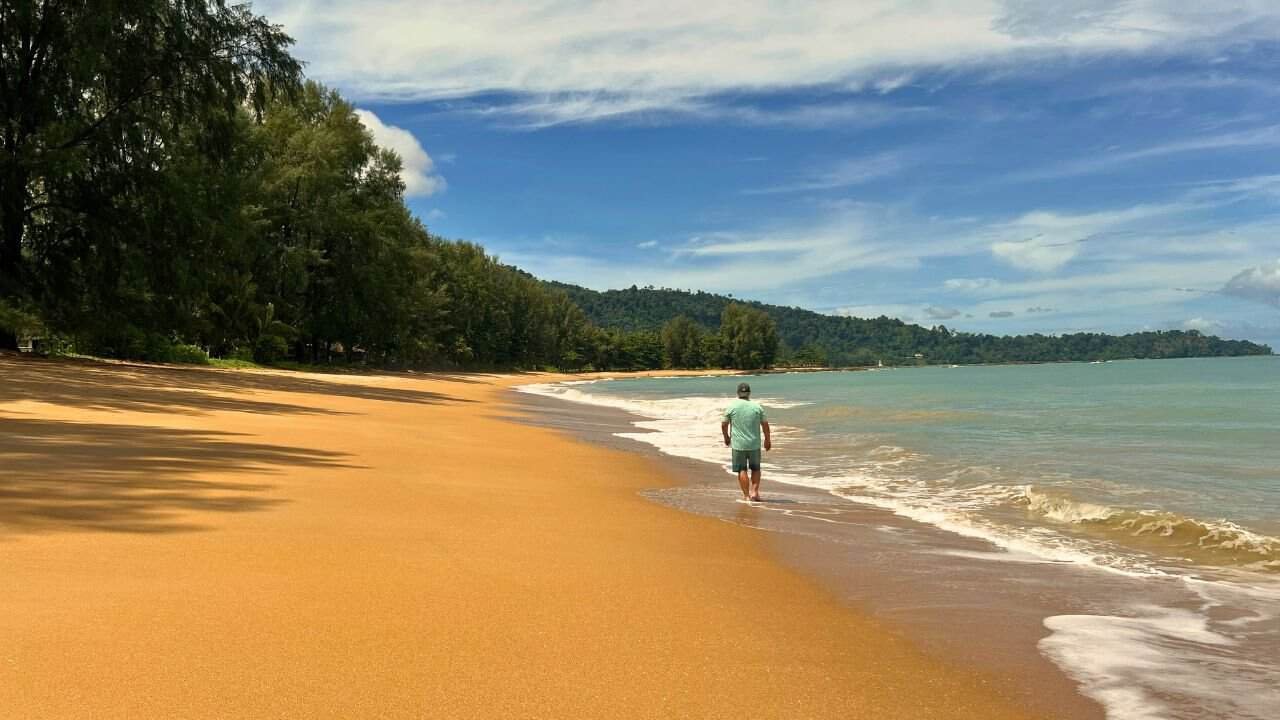
When you get there, the beach is wide and long, with the kind of sand that looks like you imagine when someone says beach. That golden colour that looks clean and welcoming.

There had been some significant erosion from storms during the previous year and parts of the shoreline showed it, but there was still more than enough beautiful beach to walk.
A word on swimming: the depth drops off close to shore, which can make ocean swimming feel uncertain if you’re not a confident swimmer. There are sections protected by rocks, though, and we found those ideal for a proper swim without fighting the current. Worth knowing before you arrive.
What We Did Beyond the Pool
We visited a couple of waterfalls, which were genuinely worth the trip out. We also spent a morning at an ethical elephant sanctuary, the Khoa Lak Elephant Conservation, which was one of those experiences that stays with you long after you’ve left.
If you’re going to visit elephants in Thailand, take the time to find an operation that actually looks after the animals properly.

Those places exist and are not hard to find with a bit of research. Please never ride an elephant, it may look like fun, and to be honest we did it many years ago before it was widely known how those places mistreat the animals, but they are not meant for riding.
The islands off Khao Lak are typically a highlight of the area, with amazing snorkelling around the Similan Islands in particular. In low season, those trips don’t run.
That was the one genuine disappointment of the week. It didn’t ruin anything, but if snorkelling or island day trips are the main reason you’re going, low season is not your window unless you are willing to make it a longer day and take the trip from Phuket to somewhere like Phi Phi Island.
The Food: Resort and Local
Breakfast was included in our rate and it was very good, with a wide range of options at a quality level that made it easy to linger. The resort also has a pool bar that handles lunch well, and an Italian restaurant on site that we tried one evening and which was genuinely excellent. Better than you’d expect from a hotel restaurant.

Most nights, though, we didn’t eat at the resort. The local Thai restaurants nearby are cheap, informal, and very good. The kind of family run places where the menu is short and everything on it is worth ordering. We went back to a couple of them more than once.
What Surprised Us: The Weather and the Service
The service at the resort stood out in a way we didn’t fully anticipate. Guest numbers were noticeably down, but staffing levels weren’t. What that means in practice is that the staff had time to have proper conversations, remember what you’d ordered the day before, and interact with guests the way you imagine resort staff would if they weren’t stretched thin.
It was some of the most attentive, unhurried service we’ve experienced at this level.
The weather also reminded us of something we already knew but had slightly talked ourselves around. Wet season in this part of Asia is not what the name implies.
Of the eight days we were there, six had a heavy downpour for roughly an hour, and the skies cleared for the rest. One day was a genuine full-day rain event. We spent it at the pool anyway, because the water was warm, the day was still hot, and neither of us particularly minded getting wet.
We’ve spent time across Asia over the years, and the pattern holds pretty reliably: wet season almost always means a daily shower, not a week of grey drizzle. If you’ve spent time in Queensland over summer, it’s not entirely unlike that.
Worth naming honestly: about 30 percent of resorts in the area were closed or clearly in maintenance mode, and roughly the same proportion of market stalls and restaurants weren’t operating.
It was noticeable. But what remained was more than enough. The Bang Niang night market still had food, clothing, and the same souvenirs you can find at every night market across Southeast Asia.
We could have eaten at a different restaurant every night for another few weeks and not repeated ourselves.
The closure rate sounds like a negative until you’re actually there and realise how many places there are that are still open for business.
The Practical Details
When to go: Low season on Thailand’s Andaman coast runs roughly May to October, with June through August being the quietest period. If you’re going for weather guarantees, this isn’t your window. If you’re going for value, quiet, and a more personal experience, it might be exactly your window.
How long to stay: A week was right for us. Khao Lak isn’t a fast-paced destination in any season. It suits a slow stay.
Getting there: Khao Lak is served by Phuket International Airport, about an hour and a half north. We booked a private driver online and the experience was excellent: a large clean vehicle, reliable service, and a fair price. Worth sorting in advance rather than hunting for transport at the airport.
Getting around: The area is flat, low-traffic, and easy to walk. A tuk-tuk is handy for getting further along the strip or to local restaurants, but day-to-day movement around the resort area is straightforward on foot.
Where we stayed: The Waters Khao Lak by Katathani. Recommended, particularly if you can get a room with access to the secondary pool area (we were in Room 102, but 101 and 103 give you the same private pool vibe. Breakfast included is worth having.
What it cost: Accommodation rates in low season can be significantly lower than peak. We got a very good deal at a resort that would have cost considerably more in November or December. Worth checking a few dates on either side of your preferred window.
Is Khao Lak Right for You After 50?
Best for: Couples who want genuine beach time without competing for space. Anyone finishing a longer Asia trip who needs a proper decompression stay before going home. Travellers who have done Phuket and want the same general geography with considerably less noise around it. People who are happy to eat well without needing a huge range of options to choose from.
Think carefully if: Snorkelling or island trips are the main event for you, because low season closes that option. If you want lively nightlife, a busy resort atmosphere, or easy access to shopping beyond local markets, Khao Lak is going to feel thin regardless of the season.
Would We Go Back?
Yes, and probably in low season again.
The combination of price, quiet, and the particular pace that only arrives when a destination isn’t performing for a full crowd suits how we travel now. A week was right. Long enough to properly rest, not so long that the limited town options became a constraint.
For what it’s worth, I had booked my nephew’s honeymoon in Khao Lak a few months before we visited. They loved it. That’s a decent endorsement to have in your back pocket before you arrive.
What Khao Lak Taught Us About Low Season Travel
Here’s what we actually learned, and it applies well beyond Khao Lak.
“Low season” is a label that carries more weight than it usually deserves. It means fewer tourists, some businesses closed, and weather that’s less predictable. All of that is true. What it doesn’t automatically mean is that you shouldn’t go.
To be fair to the concern: there are places where low season is a genuine no. Destinations where the weather doesn’t just interrupt your day with an hour of rain but makes the thing you came for completely inaccessible.
Or where cyclone or flood risk is real enough that the savings come with a very good reason attached. In those cases, cheaper means cheaper for a reason, and no amount of contrarian thinking changes that. Do your research and listen to what you find.
But in most places, low season means something far more manageable. A bit less convenient. A few fewer options. Some stalls closed at the market. The odd restaurant not yet open for the season.
In exchange for that, you get lower prices, quieter spaces, and often a version of the destination that’s closer to how it actually lives when it’s not putting on a show for a crowd.
The version of Khao Lak we experienced: a resort pool that felt privately ours, restaurant tables we walked straight into, staff with the time to actually pay attention, a four-star rate that felt like a genuine bargain.
That version exists specifically because most people looked at “June, wet season” and decided to go somewhere else.
We didn’t know we were making a clever decision. We were just booking a beach week. But the lesson landed anyway.
The useful question to ask before ruling out low season anywhere isn’t “is this the right time of year?” It’s “what does low season actually mean here, specifically?”
A bit of research into what the weather pattern really looks like day to day, what actually closes, and what the place is like without the crowds might change your answer entirely.
It changed ours.
Planning your own trip?
These are the resources we use ourselves