How to Choose the Right Destination for a Longer Stay

Choosing a destination for a longer stay is not the same as choosing somewhere for a holiday.
A place can be ideal for four busy days of sightseeing but lose its appeal once the attractions have been ticked off. Another destination might seem less exciting at first, yet offer exactly the cafés, neighbourhoods, transport and everyday comforts you need to enjoy several weeks there.
That is the real challenge. You are not only choosing what you want to see. You are choosing where you might enjoy waking up when there is nothing in particular on the itinerary.
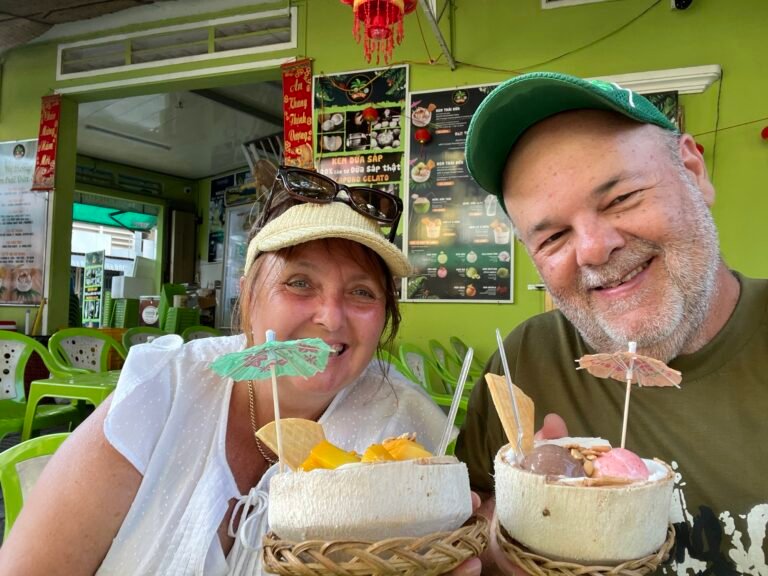
We began to understand the difference during our second visit to Hoi An.
Our first stay lasted four nights, giving us enough time to explore the Ancient Town and visit some of the main attractions. When we returned for two weeks, there was room for a different kind of experience.
During that visit, we discovered what two weeks in Hoi An could realistically look like when sightseeing, everyday expenses and deliberately quiet days were all included.
We still planned sightseeing days, but there were also early walks, regular coffee shops, quiet afternoons and days when very little happened. Instead of constantly asking what else we needed to see, we began discovering what it felt like simply to spend time there.
Hoi An hadn’t changed. The way we experienced it had.
That stay helped shape how we now think about retirement travel. It also taught us that a longer stay eventually needs to support ordinary life, not just provide a longer list of things to do.
Here is what we now consider when deciding whether a destination might be right for a few weeks or longer.

Start with the life you want to live there
Before researching destinations, think about what you want your days to look like.
Do you want to explore somewhere new every day, or would you prefer to establish a comfortable routine? Are you hoping to relax, work on a personal project or use one destination as a base for exploring the surrounding area?
There is no single correct version of a longer stay.
For one traveller, it might mean renting an apartment overseas for three months. For someone else, it could mean spending ten nights in one town instead of moving through three destinations in the same period.
Both can provide more time to experience a place. The important thing is to choose a destination that supports the kind of stay you actually want.
Hoi An worked for us because we enjoyed having a mixture of activities and unplanned time. We could visit Mỹ Sơn or take a cooking class one day, then spend the next walking through quieter streets, trying another coffee shop or relaxing beside the pool.
Someone looking for a new major attraction every day might reach a different conclusion about the same town.
The same principle applies to deciding how much of your trip to plan in advance. The right balance depends on how much structure helps you and when it begins to feel restrictive.
Don’t begin with somebody else’s list of the best slow-travel destinations. Begin with the way you would like to spend your time.
Look at what remains after the sightseeing
The major attractions still matter, especially when it is your first visit. But they may only fill the first few days.
What will you do after visiting the historic centre, taking the popular tour and photographing the famous viewpoint?
This is when the less celebrated parts of a destination become important: neighbourhoods that are enjoyable to explore, local markets, parks, waterfronts, walking routes and cafés where you would happily spend an hour.

You also need enough affordable places to eat and a few things to do that don’t require a tour booking or an entire day.
These details rarely dominate lists of the “best things to do”, but they may matter more during the second or third week than another attraction.
This was one of the differences we felt between Hoi An and Nha Trang.
There was nothing particularly wrong with Nha Trang. We had comfortable accommodation, plenty of restaurants and a long beach nearby. It simply didn’t click with us. After a week, we didn’t feel that staying longer would improve the experience.
Hoi An was different. Beyond the obvious attractions, we enjoyed the coffee shops, backstreets, surrounding countryside and the ability to divide our time between the Ancient Town and the beach. There was enough variety to keep us interested, but we never felt pressured to be constantly doing something.
More attractions don’t necessarily make a destination better for a longer stay. Sometimes what matters most is how much you enjoy the time between them.
Be realistic about walkability and transport
We are much more careful about the word walkable than we used to be.
A hotel might be described as being only 500 metres from the centre, but that doesn’t tell you whether the route has proper footpaths, involves a steep hill or requires crossing several lanes of busy traffic.
It also doesn’t tell you how that walk will feel in heat, humidity or heavy rain.
Look beyond the distance to the main attractions. Can you comfortably reach restaurants, cafés, a supermarket, a pharmacy and public transport? Is the surrounding area pleasant to walk around after dark?
If the destination isn’t particularly walkable, that does not necessarily rule it out. The more important question is whether there is an easy and affordable alternative.
In Heidelberg, we stayed in Handschuhsheim, a quieter and less expensive area outside the historic centre. We were on a direct tram line, so getting into the centre was quick and easy. We had the benefits of staying away from the busiest area without feeling isolated from it.
That experience reminded us that central is not always better. A slightly more distant neighbourhood may provide better value and a quieter place to return to, provided the transport connection works.
Check the frequency and operating hours as well as the route itself. Saving money on accommodation won’t help much if reaching town requires two expensive taxi rides every day.
Choose accommodation for function, not its label
There is a common assumption that a longer stay requires an apartment. It doesn’t.
An apartment can be an excellent choice, particularly if you want a kitchen, washing machine and separate living area. But a suitable hotel can work just as well and sometimes make the stay considerably easier.

During our two weeks in Hoi An, we stayed in a hotel rather than an apartment. Our room was spacious, breakfast was included, the staff cleaned the room and changed the bedding, and there was a swimming pool where we could relax during the hottest part of the day. Affordable laundry was also easy to arrange.
We didn’t have to worry about cleaning, shopping for breakfast ingredients or working out how to operate an unfamiliar washing machine. For the way we wanted to stay, the hotel facilities were an advantage rather than a compromise.
The real question isn’t whether you should book a hotel or an apartment. It is whether the accommodation supports your daily life.
For a longer stay, we look for:
- Enough room to unpack and store our belongings
- Comfortable seating that isn’t the bed
- Natural light
- Reliable Wi-Fi
- A refrigerator
- Convenient and affordable laundry
- Suitable cleaning and bedding arrangements
- Enough space that we are not constantly falling over each other
You may not need everything on that list. Decide which facilities will make a genuine difference to your stay and which ones merely sound appealing in the listing.
A room that works perfectly for three nights may become frustrating after three weeks. Read reviews from longer-stay guests where possible, and look beyond the photographs of the bed, bathroom and balcony.
If something important isn’t mentioned, ask before booking. Laundry and comfortable chairs aren’t glamorous travel subjects, but give them two weeks and they can become surprisingly interesting.
Research the neighbourhood, not just the destination
We learned this lesson rather noisily on Isla Holbox in Mexico.
We wanted to stay close to the beach. Because we didn’t know how easy it would be to walk around the island, we also thought it made sense to remain near the centre.

On a map, our chosen hotel appeared to offer the best of both worlds.
What the map didn’t reveal was that the hotel operated a rooftop nightclub. Directly across the road was another nightclub, and the two spent every evening competing to see which could play the loudest music until about three in the morning.
We had certainly placed ourselves in the centre of things. Far more things than we had bargained for.
Holbox turned out to be easy to explore on foot, so we could have stayed somewhere much quieter without sacrificing convenience. Had we researched the immediate surroundings more carefully, rather than concentrating on the distance to the beach and town centre, we might have made a very different choice.
Before booking, examine what is actually around the property. Look for busy roads, entertainment venues, transport terminals and construction sites as well as restaurants, cafés and supermarkets.
Recent reviews can be particularly revealing. Search within them for words such as noise, music, traffic, stairs and construction. Satellite maps and street-level images may also reveal things that have been carefully kept outside the accommodation photographer’s frame.
The right destination with the wrong neighbourhood can make a longer stay unnecessarily difficult.
Consider the climate beyond the average temperature
Mérida in Mexico appeared to have almost everything we would want from a longer-stay destination.
It is an attractive and culturally interesting city, with good food, useful services and plenty to explore nearby. In most respects, we could imagine basing ourselves there for an extended period.
Then there was the heat.
Mérida’s oppressive heat and humidity affected how comfortable it was to spend time outside and how much we could reasonably do during the day. It didn’t make Mérida a poor destination, but it did make us question whether it would be the right longer-stay destination for us at that time of year.
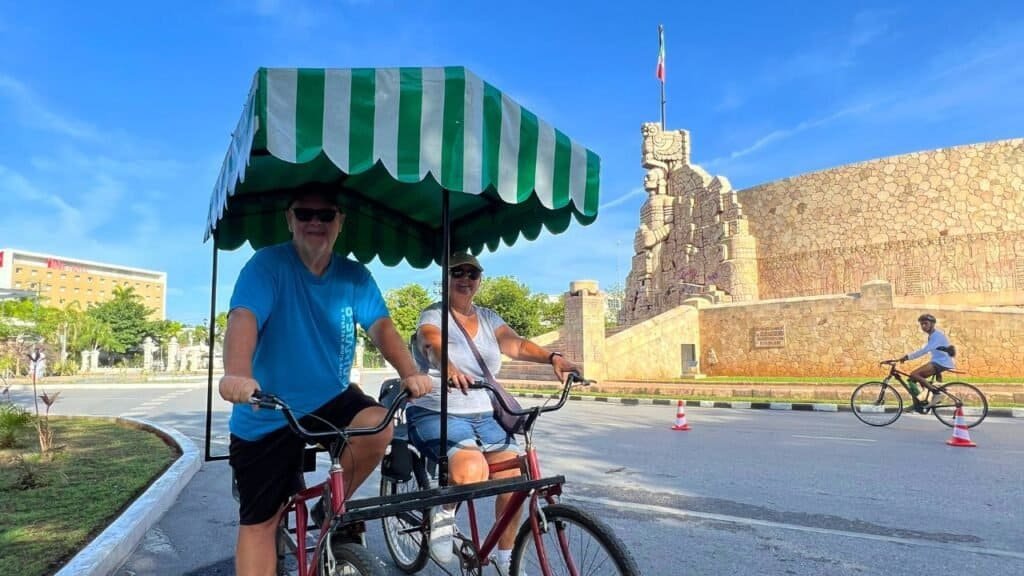
Average temperature figures only tell part of the story. Humidity, rainfall, wind and the strength of the sun can make two destinations with the same forecast feel completely different.
Research the weather for the month you intend to visit, including overnight temperatures and typical humidity. It is also worth checking for seasonal flooding, storms, bushfires or business closures.
Most importantly, compare those conditions with the life you have imagined.
If you want to explore extensively on foot, persistent heat and humidity could make the destination difficult. If your plans revolve around beaches and outdoor dining, frequent rain or strong winds may matter more than a slightly cheaper room.
We visited Hoi An during a hot period and adjusted by going out early, slowing down during the hottest part of the afternoon and heading out again later. That worked because our longer stay gave us the flexibility to organise our days around the conditions.
Weather does not have to be perfect. It does need to be compatible with what you want to do.
Calculate the cost of living your way
Almost every destination has an article or video explaining how someone lived there for a remarkably small amount of money.
That figure is only useful if you want to travel the same way they did.
The relevant question isn’t, “How cheaply can someone stay here?” It is, “What will it cost us to stay here comfortably?”
Start with accommodation you would genuinely be happy to book. Then add the meals you are likely to eat, local transport, coffee and treats, laundry, mobile data and the activities you actually want to do.
Longer stays may reduce some expenses. Weekly or monthly accommodation discounts can be available, laundry becomes easier to organise and you probably won’t pay for a major attraction every day.
Other costs can quietly increase. A cheaper property outside town might require regular taxis. An apartment may reduce your restaurant spending but leave you paying more for transport to supermarkets. In a hot climate, air conditioning may be essential rather than an optional extra.
Our approach is not to find the lowest budget anyone has achieved. It is to estimate what the destination will cost when travelled in a way we would enjoy.
There is little value in proving that you can afford a month somewhere if you have to spend the entire month travelling in a way that makes you miserable.
Check whether ordinary life will be easy enough
Practical details rarely inspire anyone to choose a destination, but they can determine whether a longer stay works.
You don’t need to prepare for every possible problem. You do need to understand how you will buy groceries, arrange laundry, access money and get around once you are there.
Access to medical care and pharmacies may also matter, particularly if you take regular medication. Reliable internet might be essential if you need to work, manage bookings or remain in contact with family.
A small coastal village can be perfect if you have your own transport and enjoy peaceful days. The same place may feel restrictive if there is one small shop, limited public transport and nowhere nearby to buy dinner on certain nights.
This doesn’t mean every longer stay needs to be in a large city. It means understanding how the destination functions when you are not sightseeing.
During a short visit, an awkward transport system or limited selection of shops may be a minor inconvenience. Over several weeks, it becomes part of daily life.
Decide how much familiarity and variety you need
One of the pleasures of staying longer is watching an unfamiliar place become familiar.
You begin recognising the streets, returning to a favourite café and walking to dinner without checking the map. You stop feeling as though every day needs to justify the cost of the trip.
Pauline and I both enjoy that growing familiarity, but we also need some variety. Pauline is always happy when beach time can become part of the mix, while we both like having different neighbourhoods, nearby towns or day trips available when we feel like exploring.
Our split stay between Quy Nhon and Bai Xep in Vietnam, highlighted how much the right balance can vary.
We explored the differences between staying in Quy Nhon and Bai Xep in more detail after discovering how two places only 20 minutes apart could create completely different trips.
Quy Nhon provided city convenience, a wider choice of restaurants and easier access to services and excursions. Bai Xep offered a much smaller village atmosphere with the beach directly in front of us.
Neither was better. They simply suited different kinds of stays.
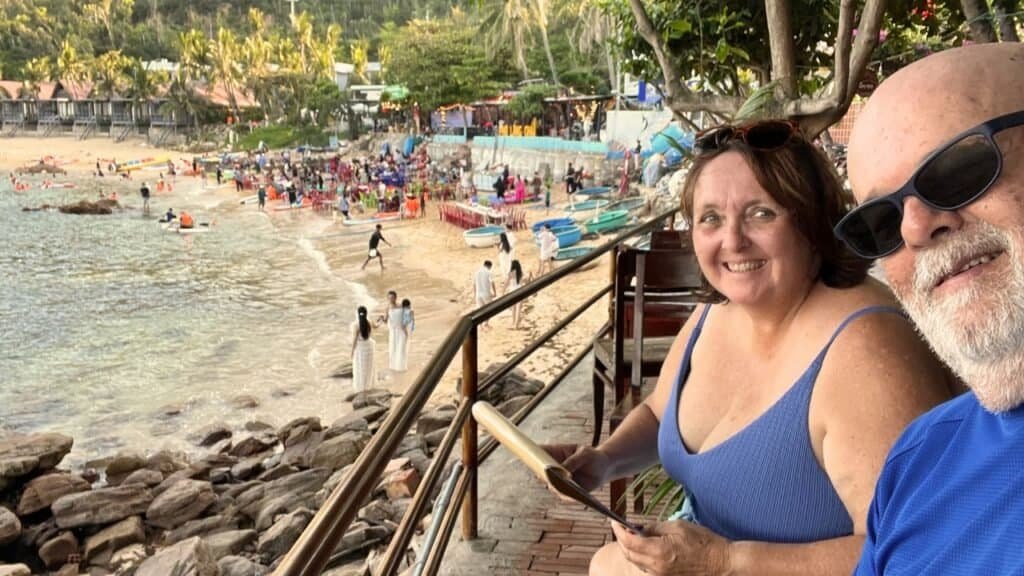
A few quiet days in Bai Xep worked beautifully. For a longer period, we might have missed the convenience and variety available in Quy Nhon. Someone wanting to withdraw from busy city life might make exactly the opposite choice.
Ask yourself whether you would enjoy returning to the same handful of places or whether you need regular changes of scenery. If you want both familiarity and variety, look for a base with contrasting neighbourhoods or worthwhile day trips nearby.
Choose the length after choosing the destination
Slow travel has somehow acquired an unofficial minimum stay.
Longer stays can also form part of a much bigger decision about whether you want to travel with a permanent home base or become a full-time nomad.
A week supposedly isn’t long enough. A month is better. Three months is even more authentic, presumably because you eventually learn which day the rubbish bins go out.
We don’t think the value of a stay can be measured by counting nights.
A week at a resort in Khao Lak suited what that particular stay was about. We wanted time to relax rather than an endless list of attractions. Staying longer would not automatically have made the experience more meaningful.
Our experience of visiting Khao Lak during low season also showed us why seasonal labels need more investigation before ruling a destination in or out.
In Hoi An, two weeks gave us time to move beyond the first-visit highlights and develop a comfortable routine. By the end, we felt we could easily have stayed longer.
Nha Trang showed us the other side. After a week, we had enjoyed parts of the city but still weren’t particularly drawn to it. Booking another two weeks would not necessarily have created a connection that wasn’t there.
This is why we prefer to consider the destination and purpose of the trip before deciding how long a stay should be.
Before committing, ask:
- Will we enjoy ordinary days here?
- Is there enough variety for the way we travel?
- Does the climate suit what we want to do?
- Will the accommodation remain comfortable?
- Can we get around easily?
- Are there worthwhile day trips if we want a change?
If you are unsure, consider testing the destination before making a longer commitment. A week or two can reveal a great deal about how a place works once the initial excitement begins to fade.
Longer is not automatically better. The right length is enough time to experience the destination at your preferred pace without staying simply because slow travel supposedly requires it.
Choose somewhere that works beyond the photographs
The best destination for a longer stay is not necessarily the most beautiful, famous or affordable place on your list.
It is the place that supports the kind of days you want to have.
For us, that usually means somewhere comfortable and reasonably walkable, with good food, coffee, interesting streets and enough variety for the days when we want to explore. It also means having the freedom to slow down without feeling that we are missing the entire point of being there.
Your priorities may look quite different.
You might value beaches, museums, hiking, public transport or complete peace and quiet. None of those preferences makes one version of travel more authentic than another. What matters is being honest about them before committing several weeks to a destination.
Our second visit to Hoi An helped us understand that a longer stay wasn’t simply a short holiday stretched across more days. It gave ordinary life enough time to become part of the experience.
That doesn’t happen just because you book accommodation for a month. It happens when the destination, neighbourhood, accommodation and pace work together.
The goal isn’t to stay as long as possible. It is to stay long enough to experience a place properly, while recognising that more time will not always make it the right place for you.