Retire & Reset Review: Could This Be a Better Way to Spend a Month Overseas?

If you’ve ever found yourself thinking about spending a month or more overseas instead of your usual one or two-week vacation, you may also have realised it raises a whole new set of questions.
When you’ve only got a week or two, it’s natural to pack every day with things to see and do. But once your trips start stretching towards a month or longer, more option open up to you.
You start thinking less about ticking off attractions and more about how you might actually spend your days.
Would we enjoy staying in one place for that long? Would we miss constantly moving on? How much sightseeing would we still want to do? Would we end up feeling lonely or bored?
If those are the kinds of questions you’ve started asking yourself, then you will probably find this article interesting and useful.
Why a month changes everything
For decades, most of us travelled the same way because that’s all the time we had. We squeezed as much as we could into a week or two away, came home exhausted and in need of another vacation.
For people approaching retirement, or those who have already retired, that starts to change.
Instead of asking, “Where can we go for two weeks?” more people are beginning to ask, “What could we do with a month or more?”
Having more time opens up possibilities that simply don’t exist on a shorter trip. You can settle into a destination, discover places beyond the obvious tourist attractions, and travel at a pace that actually feels enjoyable.
But it also raises a new set of questions.

Do you organise everything yourself? Do you stay in one place for the whole month? How much sightseeing would you really want to do? Would you enjoy having other people around, or would you rather be completely independent?
They’re questions we’ve found ourselves asking too.
With my experiences as a travel agent and a few years working as a tour designer, I’ve often found myself thinking about whether there was another way to travel with a group.
Something very different from the traditional “on the bus by eight o’clock” style of tour where you’re packing your suitcase every morning and moving on every couple of days.
Those tours suit plenty of people and the companies running them usually know how to look after “seasoned” travellers, but I’d always wondered if there was a way to combine the freedom of independent travel with the comfort of having a community around you whenever you wanted it.
It was a style of travel I believed was a missing piece of the retirement travel puzzle, but one I could never quite work out.
Then, just before Pauline and I left for two months travelling through Asia, we were contacted by a couple who seemed to have done exactly that.
At least, that’s how it looked on paper.
Spending time with Retire & Reset
Just before we left for two months travelling through Asia, we received an email from a couple named Vivienne and Clarence.
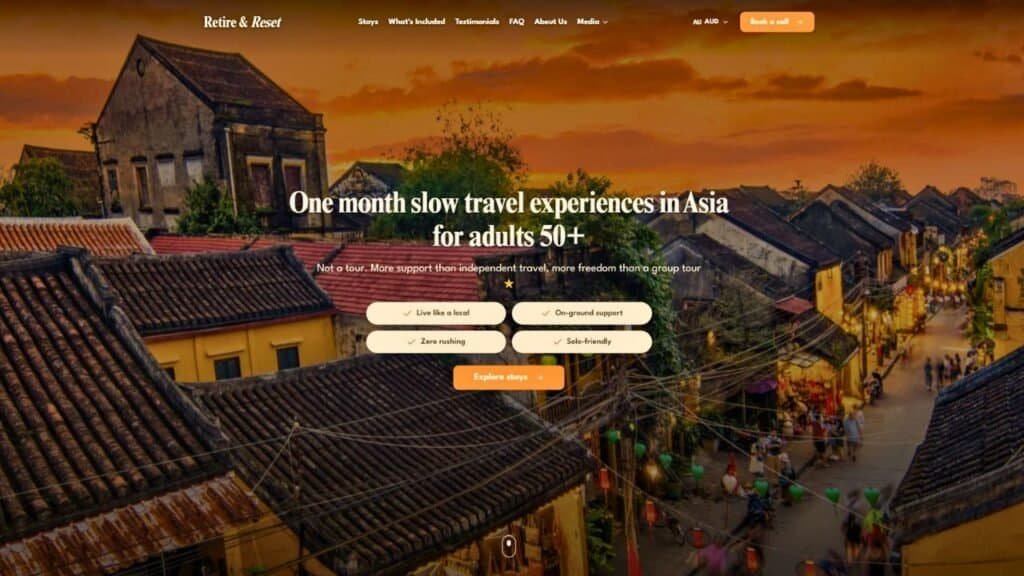
They’d recently launched a business called Retire & Reset, built around month-long hosted stays for people approaching or living in retirement. They’d come across Next Stop Retirement and thought we might be interested in what they were trying to create.
Their timing wasn’t ideal, but we hadn’t given up on getting at least a glimpse into how they were trying to make this work.
Our itinerary meant we couldn’t join one of their hosted months from start to finish, but we were going to be near Da Nang, in Hoi An, while one of their groups was there.
Instead, they invited us to spend an evening with everyone, meet the guests, and see what a hosted month actually looked like. It was too good an opportunity to pass up.
Not because we were looking for another destination to feature, but because we were genuinely curious about a style of travel we’d never experienced before.
When we arrived at the guesthouse, Vivienne and Clarence were waiting outside to greet us before introducing us to the group.
Our first impression was just how relaxed everything felt.
There wasn’t a tired tour, worn out from another day of hectic, scheduled sightseeing. People were chatting over coffee, discussing how each of them had spent their day, or simply enjoying some quiet time around the guesthouse.
It felt less like gatecrashing a tour group and more like dropping in on a group of friends who happened to be living in the same place for a month.
After showing us around the guesthouse, we sat down with Viv for a chat. There was one question I couldn’t resist asking.
“Can I ask why two people in their 30s decided to build a travel business for people in retirement instead of people your own age?”
It seemed like an obvious question, but her answer wasn’t what I expected. Retire & Reset wasn’t created because Viv and Clarence spotted a gap in the market.
It started because of Viv’s mum.
She wanted to spend longer overseas, but organising everything herself felt overwhelming. Traditional tours moved too quickly to really settle into a destination, while travelling completely independently felt like too big a step.
So instead of trying to convince her to travel differently, they started wondering whether they could create something that sat somewhere in between.
Listening to that story, I found myself looking at the whole concept differently. It no longer felt like a business that had been designed first and marketed to retirees afterwards.
It felt like an attempt to solve a problem for someone they cared about.
Living the experience
That evening wasn’t organised as a showcase for us. It was simply one of the optional weekly outings that guests could join if they wanted to.
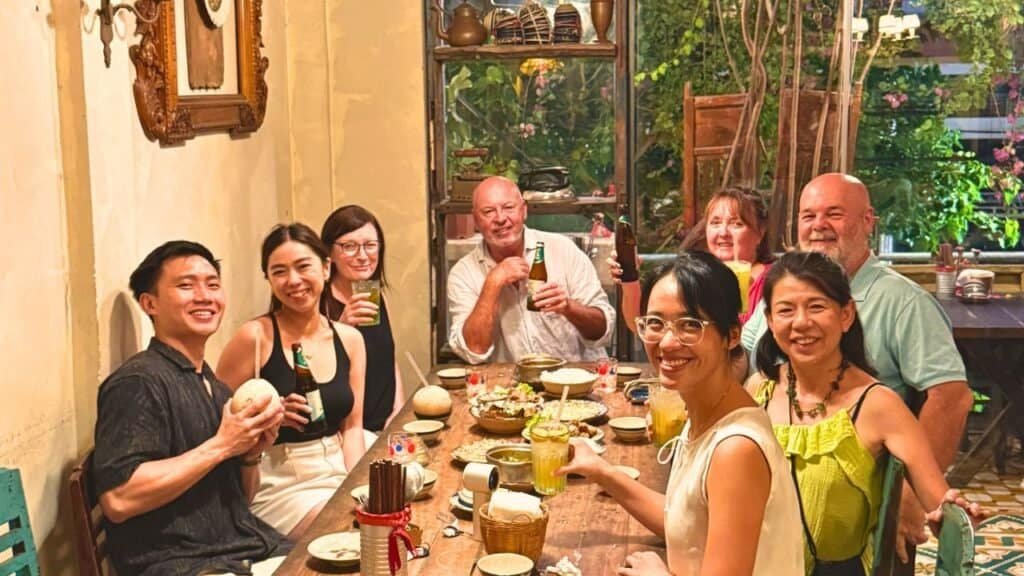
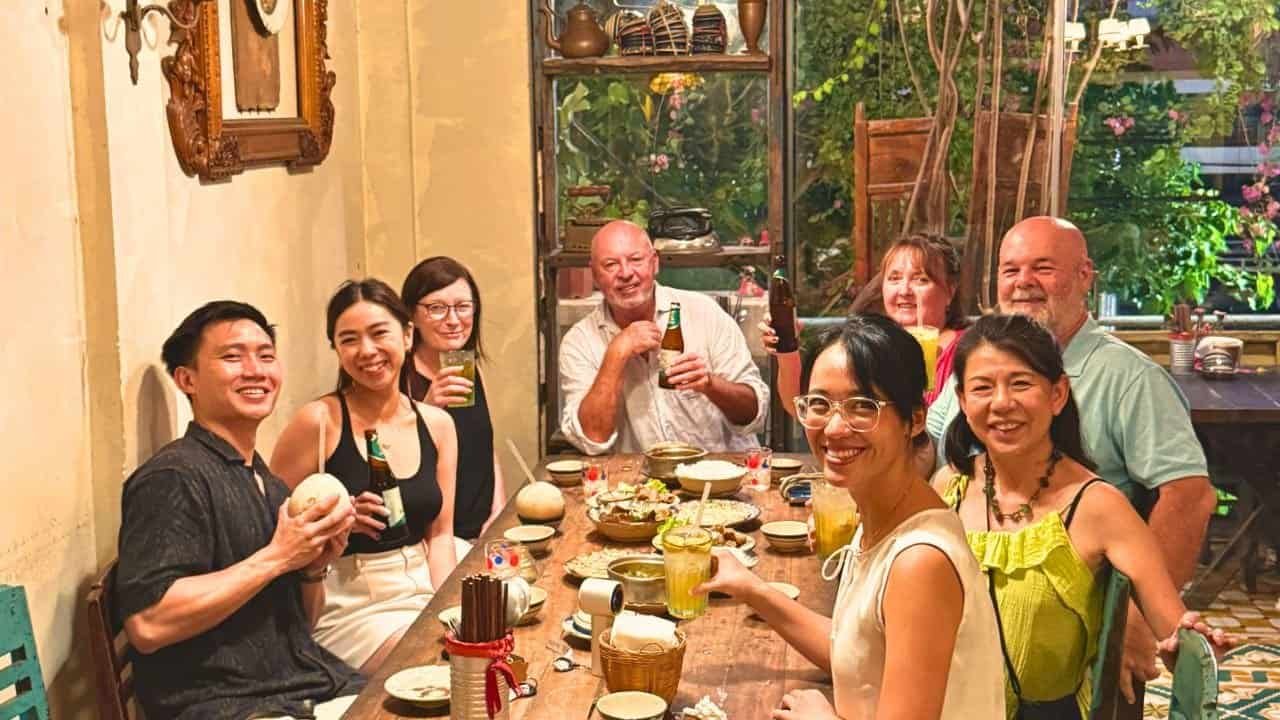
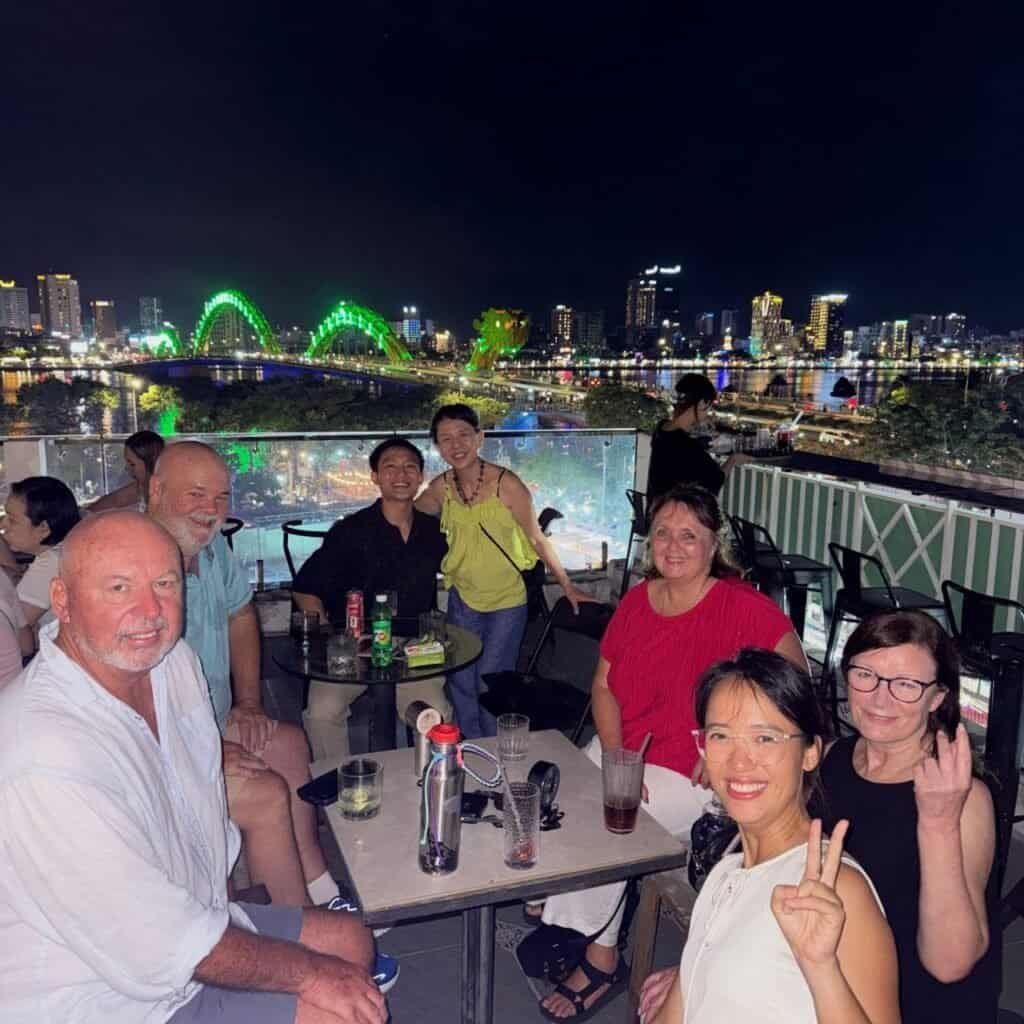
We started with dinner at an old family-run Vietnamese restaurant before wandering along the river and eventually finishing at a rooftop bar overlooking Da Nang’s famous Dragon Bridge. The rooftop bar had a section reserved for our group, just another nice little touch.
On the surface, it probably looked like any group of friends enjoying a night out together. But the more we listened, the more we realised something interesting was happening.
People weren’t talking about activities Retire & Reset had organised for them that day. They were talking about places they’d found themselves. A café someone had stumbled across. A market another couple had spent the morning exploring. A beach walk planned by one of the guests for the following morning that anyone was invited to join.
The organised evening wasn’t replacing independent travel. It was giving people a chance to come back together afterwards.
That struck me as an important difference.
One of the things I’d always wondered about this style of travel was whether it might become too structured. Instead, what we were seeing felt more like independent travellers who happened to have a community around them.
Pauline noticed something else.
Although everyone had booked exactly the same month in exactly the same place, it quickly became obvious they weren’t all there for the same reason.
Some loved having people to head out for dinner with. Others appreciated having local knowledge close at hand. Some enjoyed the confidence that came from knowing there was always someone around if they needed help, while others were perfectly happy spending most of the day doing their own thing before catching up with everyone in the evening.
It wasn’t one type of traveller. It was one style of travel being used in very different ways.
By the time we left that night, I was starting to think that a hosted month overseas might be a good option for us.
But I was definitely convinced that it could work, and be a wonderful option for a lot of people.
Why it worked for different people
Driving back to Hoi An that evening, Pauline made an observation that seemed obvious at the time.
“It’s funny,” she said. “Everyone seems to love it, but for completely different reasons.”
I was only half listening but I remember agreeing with her, even though we had only spent a few hours with the group. It wasn’t until the hosted month had finished and I sat down to watch the testimonials some of the guests had recorded that I realised just how right she was.
I wasn’t looking for glowing testimonials. I wanted to know what people had really come away with after spending a month there.
Confidence
The first interview that really caught my attention was Paula’s.
At 70 years old, this was her first trip to Asia and her first solo overseas adventure. What stood out wasn’t that she loved Vietnam. Why wouldn’t she?
It was how often she talked about feeling comfortable.

She admitted she’d been nervous before the trip, but knowing the accommodation, local support and community were already in place allowed her to simply enjoy the experience instead of worrying about every little detail.
Confidence was what she’d been looking for.
Freedom
Peter’s story couldn’t have been more different.
After travelling to more than 50 countries, he certainly didn’t need someone to tell him where to go or what to see. In fact, that was exactly what he didn’t want.
What appealed to him was the freedom to live independently, explore at his own pace and choose how much or how little he joined in, without having to organise all the logistics himself.
He hadn’t given up independent travel. He’d simply found a different way to do it.
Community
Then there was Doug.
Like Peter, he valued having plenty of freedom, but what surprised him most wasn’t the travel itself.
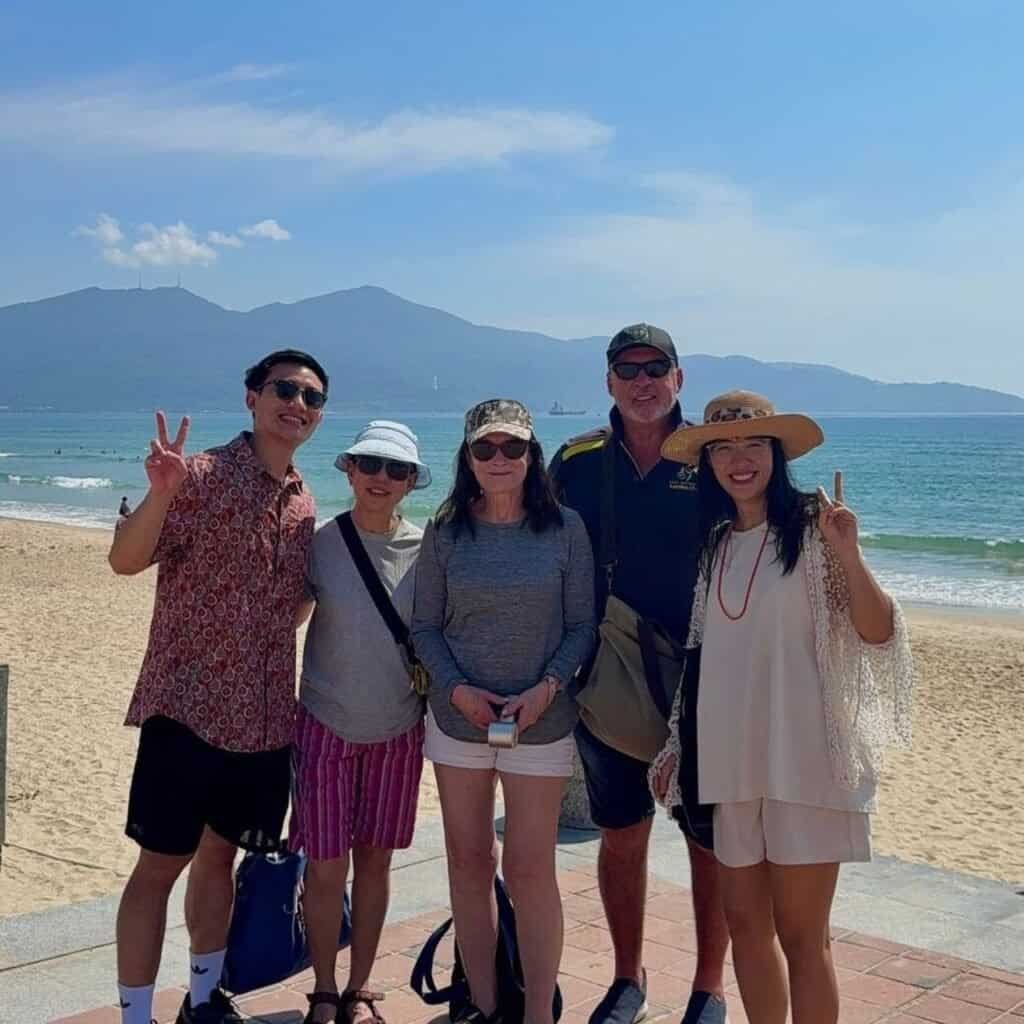
It was the people. He talked about arriving as strangers from Australia, Canada, Malaysia and the United States, then leaving as friends.
That sense of community wasn’t something he’d expected to become one of the highlights of the month, but by the end it had.
Looking ahead
Finally, there was Janet.
Her interview probably surprised me more than any of the others.
She hardly talked about Da Nang at all.
Instead, she spoke about spending time with people who were already living the sort of retirement she hoped to have herself in the near future. The conversations over morning coffee, sharing ideas for the day ahead, and learning from people who had already taken that next step in life.
She wasn’t just discovering a destination. She was getting a glimpse of what her own retirement might look like.
By the end of those interviews, Pauline’s observation made perfect sense. Everyone had booked exactly the same month in exactly the same place. But they hadn’t all booked it for the same reason. And they hadn’t experienced it in exactly the same way either.
Perhaps that’s what impressed me most. Retire & Reset wasn’t trying to create one perfect experience for one type of traveller.
It had created a framework flexible enough for different people to find value in it for completely different reasons.
Did Retire & Reset live up to our expectations?
After spending an evening with the group, talking with Viv and Clarence, and later watching the guest interviews once the month had finished, it was time to answer the question we’d been asking ourselves from the beginning.
Did Retire & Reset actually deliver the experience it promised?
For us, the answer is yes.
When we first looked at Retire & Reset on paper, it sounded like a difficult balance to achieve. Give people enough support that they feel confident travelling overseas for a month, but don’t take away the independence that makes longer stays so rewarding.
After seeing the experience first-hand, we came away believing they’d managed to strike that balance remarkably well.
The guests weren’t following a timetable. They weren’t being shepherded from attraction to attraction. They weren’t expected to spend every waking hour together.
Instead, they were encouraged to make the month their own, knowing they had comfortable accommodation, a community around them, optional social activities and practical support whenever they needed it.
One detail that particularly impressed us was the inclusion of a local host.
During the Da Nang stay that was Linh, who lived nearby and spent time at the guesthouse each day helping guests with everything from restaurant recommendations and local advice to overcoming language barriers when needed.

It wasn’t something I’d considered before seeing it in action. Afterwards, it felt like one of the smartest parts of the whole concept. Linh wasn’t there to take over anyone’s vacation. She was there to make independent travel easier.
That doesn’t mean this style of travel will suit everyone.
If your ideal month overseas involves constantly moving between destinations, or you have no interest in spending time with other travellers, you’ll probably get more value from planning the trip yourself.
On the other hand, if the idea of organising a month overseas feels a little overwhelming, if you’d enjoy having a ready-made community around you, or if you’d simply like the reassurance of local knowledge while still keeping your independence, Retire & Reset offers a strong alternative.
Nothing we saw suggested the experience was being oversold.
The stories we heard from the guests matched what we’d observed ourselves. The atmosphere felt genuine, the community had formed naturally, and the flexibility we’d been told about before arriving was clearly being lived by the people staying there.
Based on everything we experienced, Retire & Reset delivered on the promise that first caught our attention before we even boarded the plane.

What this experience taught us about hosted month-long stays
One of the goals of Next Stop Retirement is to explore different ways of travelling through retirement, not because we’re looking for one perfect answer, but because we’re curious about the possibilities.
That’s why, for us, this wasn’t just a review of Retire & Reset. It was a chance to test an idea we’d been thinking about for years.
The biggest lesson?
A hosted month overseas doesn’t have to mean giving up the freedom of independent travel. In fact, if it’s designed well, it can actually make independent travel easier.
Before spending time with Retire & Reset, I think I subconsciously imagined a hosted month would feel like a slower version of a traditional tour. What we experienced was something quite different.
Guests weren’t being told what to do each day. They weren’t expected to join every activity. They weren’t following someone holding up a flag through the streets of Da Nang.
Instead, they were creating their own month.
Retire & Reset wasn’t trying to create its version of the perfect month overseas. It gave guests the tools, support and community to create their own.
The accommodation gave people an instant community without taking away their own space. The optional social activities meant there was always something happening without anyone feeling pressured to join in.
Having Linh nearby each day removed many of the little frustrations that can chip away at your confidence without ever taking over the trip.
Looking back, that’s probably the biggest insight we took away.
A great hosted stay doesn’t exist to create an easy month away. It provides the tools to make it easy for you to create your own easy month away.
Will this style of travel suit everyone?
Of course not.
Some people will always prefer complete independence, while others will enjoy the structure of a traditional tour.
But if you’ve ever found yourself wondering whether there might be something that sits comfortably between those two extremes, we’d say this style of travel deserves serious consideration.
Not because it’s better. Simply because it might be better for you.
Who should consider Retire & Reset?
Based on everything we saw, the conversations we had, and the people we met, I don’t think Retire & Reset is trying to be the right choice for every traveller.
Nor should it be.
I think you’ll get the most from this style of travel if you like the idea of spending a month or more overseas but don’t necessarily want to do everything on your own.
You might be travelling solo and like the thought of having people to share the occasional meal or day out with.
You might be travelling as a couple but enjoy meeting like-minded people without feeling obliged to stick together all the time.
Or perhaps you’ve travelled independently for years and simply like the idea of someone else taking care of the accommodation, local logistics while still having a friendly local host available whenever you need a little help.
On the other hand, if your perfect trip involves moving to a new destination every few days, packing as many sights as possible into every week, or you simply prefer travelling entirely on your own, this really isn’t the right fit.
And that’s perfectly okay. Retire & Reset isn’t trying to replace independent travel or traditional tours. It’s offering another option that sits comfortably between the two.
For us, that’s what made this experience so interesting.
We didn’t just come away with an opinion about one company. We came away with a better understanding of another retirement travel possibility.
And for us, that’s what exploring retirement travel is all about.
Besides… there’s only one thing I can really hold against Retire & Reset…
They figured out how to make this idea work before I did.